Ranking yourself #1 isn’t the vanity move it used to be.
For years, crowning your own product at the top of your own “best software” post fooled nobody.
But Google’s AI Overview quietly changed that: done right, your self-ranking can land in the answer and read like a genuine, independent pick.
So I ran about 70 real “best [category] software” searches to find exactly when that works, and below I’ll break down the pattern, plus 5 plays to pull it off.
Let’s dive in.
How Google’s AI Overview Actually Works
For a “best X software” search, Google almost never just hands you one listicle. It writes its own ranked answer(“Best for [use case]: [tool]”) and pins a citation chip to nearly every claim. Most people get this part wrong.
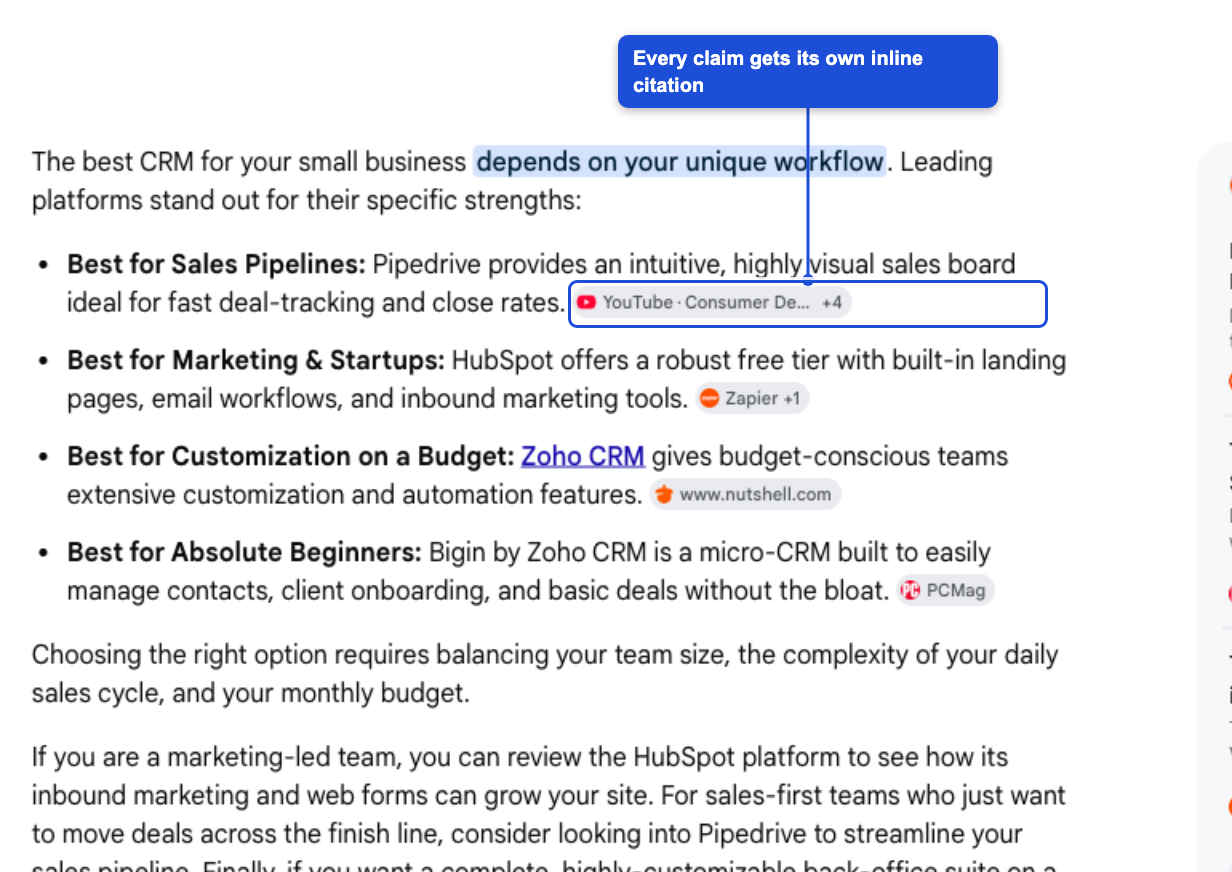
So the game isn’t “does my listicle rank.”
The game is: does Google pull YOUR name into the sentence it writes?
Rule 1: The Consensus Rule (This Is the Big One)
Google names you when other people already name you. Your own page saying you’re #1 counts for almost nothing: that’s the single biggest predictor of getting cited.
I know that sounds obvious. But across 129 head-to-head audits I ran, the winners and losers split cleanly along this line: here’s the proof.
The natural experiment: same vendor, two outcomes
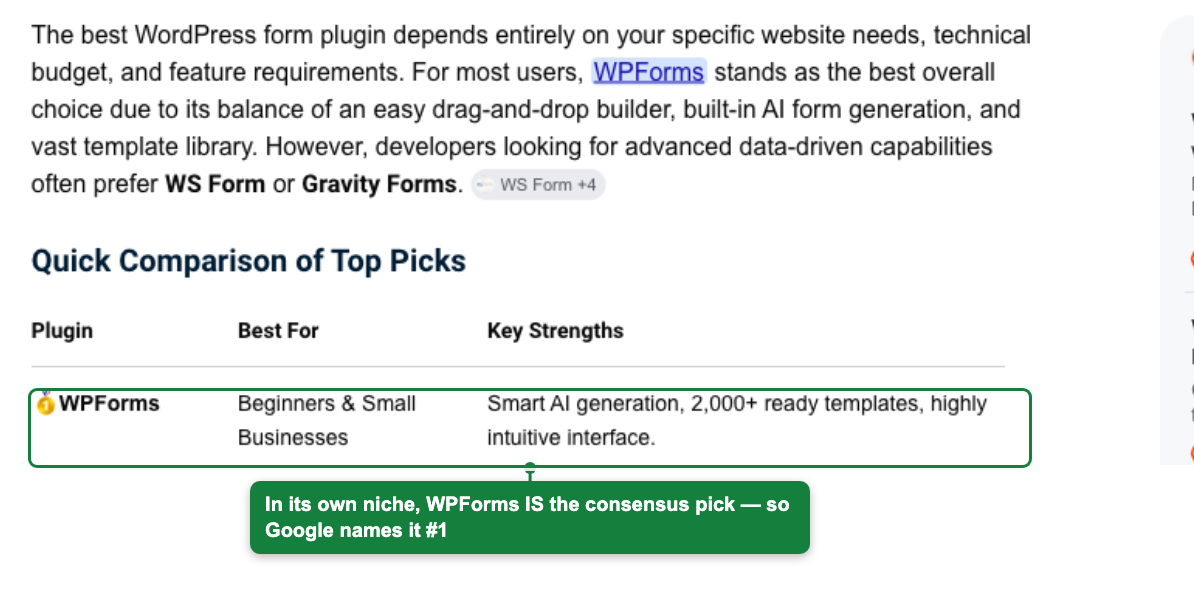
WPForms ranks itself #1 on its own blog. On both of its pages. Identical self-promotion.
Search “best wordpress form plugin” (the niche where WPForms genuinely is the consensus leader) and Google names it #1:
Now search “best online form builder” (the broader category, where the consensus is Jotform and Typeform) and the exact same #1 self-claim vanishes:
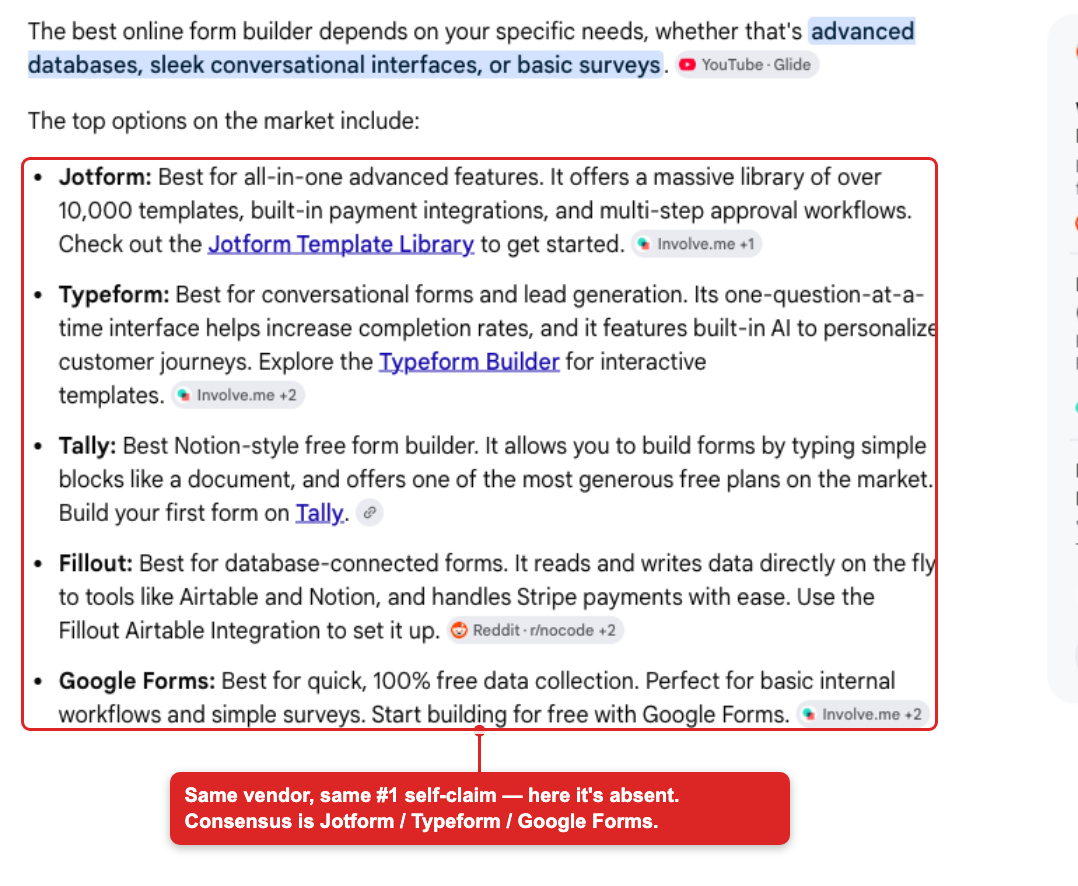
Same vendor. Same self-ranking. The only thing that changed was the consensus, and the consensus is the only thing that predicted the result.
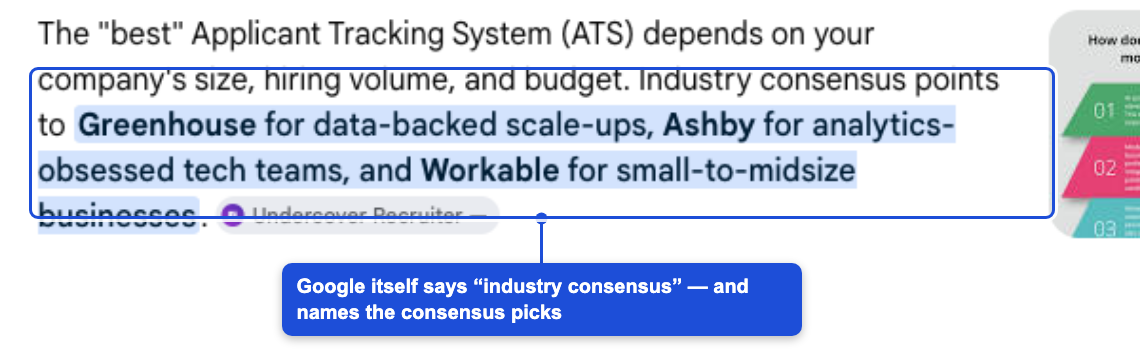
Google literally uses the word “consensus”
In fact, sometimes Google says the quiet part out loud. Search “best applicant tracking system”:
The backing ledger: who got vouched for, who didn’t
I tracked this tool by tool. The pattern held every time.
Backed by others → got cited:
| Tool | Query | Who backed it |
|---|---|---|
| VWO | best ab testing tool | Coursera and other independent roundups rank it top for marketers |
| Fieldwire | construction PM | Forbes + Construction Coverage echo its exact slot |
| PandaDoc | e-signature | Named on Zapier, G2, Aline; strong Reddit presence |
| Ramp | expense (SMB) | Top-3 in every independent list for spend/cards |
| WPForms | wordpress form plugin | OptinMonster, WPBeginner, Zapier all call it #1 |
Not backed → ignored (despite self-ranking #1):
| Tool | Query | The backing gap |
|---|---|---|
| Paymo | project management | Absent from every list; page cited only to prop up a rival |
| GetAccept | e-signature | Zero independent lists; same query PandaDoc won |
| WPForms | online form builder | Out of its niche; consensus is Jotform / Typeform |
| Apploye / Sogolytics | time tracking / survey | Self-#1, no backing; used only as a source chip |
The clearest pair sits in a single search. For “best electronic signature software,” PandaDoc and GetAccept both rank themselves #1. PandaDoc has the consensus, so Google names it. GetAccept doesn’t, so Google ignores it entirely:
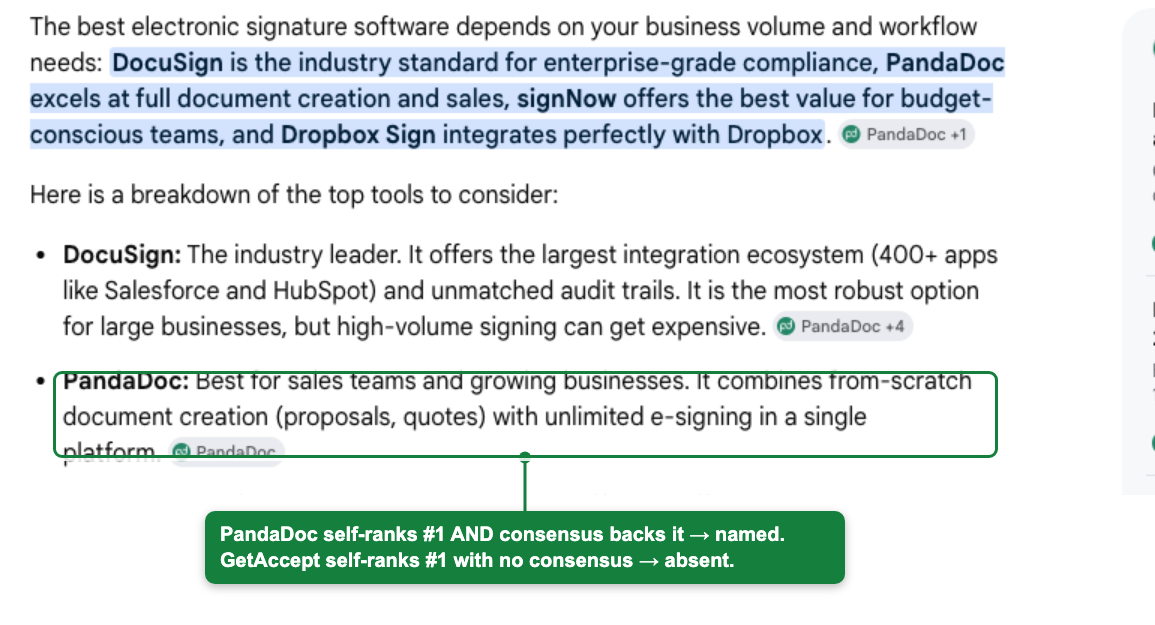
Then I put a hard number on it. For each pair I opened every source the AI Overview itself cited and counted how many actually mentioned the vendor:
A 7× gap. It’s the cleanest split I found anywhere in this study.
And here’s the trap: most losers were cited as sources in the very answer that ignored them. Being cited is not being named. If your GEO tool counts “citations,” it’s measuring the wrong thing.
Rule 2: Only Claim a Slot You Can Actually Own
Here’s the second rule, really a corollary of the first.
Don’t grab “best overall” unless you genuinely are the category’s consensus leader.
Most winners didn’t even try for the crown. They claimed a narrow “best for [use case]” slot and left the top spot alone:
- Ramp won “best for spend control & cards”; Expensify/Zoho kept “best overall.”
- Connecteam won “best for field & deskless teams”; Toggl and Clockify kept the broad picks.
- Fieldwire won “best for field task management”; Procore stayed on top.
A few vendors did win “best overall” with a self-claim (NordLayer, Shopify), but only because they truly are the consensus #1. When a weaker player tried the same grab, Google shut it down: Camtasia lost “best screen recorder” to the free-tool consensus (OBS, Loom).
So the losers all share one habit: they reach for a crown someone else owns.
Fieldwire is the model to copy. It wrote “best for task management” on its own page, and Google echoed it almost word-for-word. According to Forbes’ own construction-software roundup, the exact same slot: Fieldwire, best for task management.
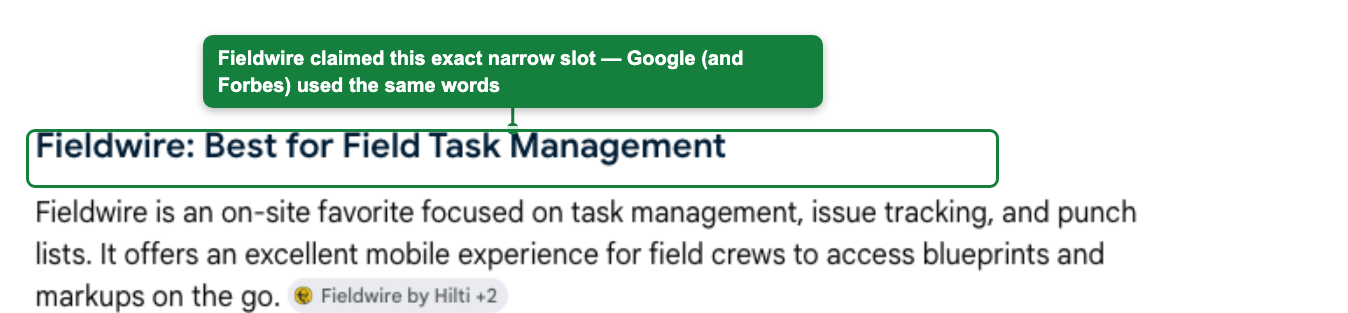
You can’t self-promote your way to a crown you don’t own. Claim the slot the market already grants you.
The Schema Myth: More Markup, Worse Odds
Schema markup does not get you cited, and heavier schema correlates with worse odds, not better. Everyone tells you to add it. So I tested it properly: I loaded 70 of these pages in a real browser (37 that got cited, 33 that didn’t) and pulled every scrap of structured data after JavaScript ran, plus headings, tables, images and word counts.
First finding: schema is table stakes, not a lever. 92% of winners have it. So do 97% of losers. Having it tells you nothing.
Second finding is the interesting one. There is a pattern, and it points the wrong way:
- Losers carried 11.5 distinct schema types on average. Winners: 7.7.
- AggregateRating (star ratings): on 24% of losers, and just 3% of winners.
- SoftwareApplication: 30% of losers, 5% of winners.
- Losers had twice the comparison tables (3.6 vs 1.7) and ran ~500 words longer.
- FAQPage, the single most-recommended tactic, was flat: 39% vs 35%. It did nothing.
The only type that leaned toward winners was plain old Article (54% vs 45%).
Read that again: the more product markup a page carried, the more likely it was ignored.
I don’t think the markup causes the loss. I think it’s a tell. Pages stacked with AggregateRating, SoftwareApplication and Offer schema are built to sell you something, and that’s exactly the kind of page Google’s answer skips over.
Two other things I expected to matter, and didn’t:
- Where your own page ranks organically. Two losers rank #1 organically for their exact query and still aren’t named. One winner doesn’t crack the top 20.
- Brand entity strength. Two of the biggest winners have no knowledge panel and no Wikipedia entry at all.
And the cleanest illustration is a pair you’ve already met. Same query: PandaDoc named, GetAccept ignored:
- GetAccept (the loser) had one of the richest pages in the study: FAQPage, AggregateRating, a WebApplication block, 11 comparison tables.
- PandaDoc (the winner) had an Article block and standard site boilerplate. No FAQ schema. No rating. No table.
The better-marked-up page lost. And one page in the study carries zero structured data at all: AppFolio’s. It won.
Stop polishing markup. It’s the price of entry, not the edge, and piling on more actively correlates with getting skipped. Go earn consensus instead.
Reddit & YouTube Are Now Inside the Answer
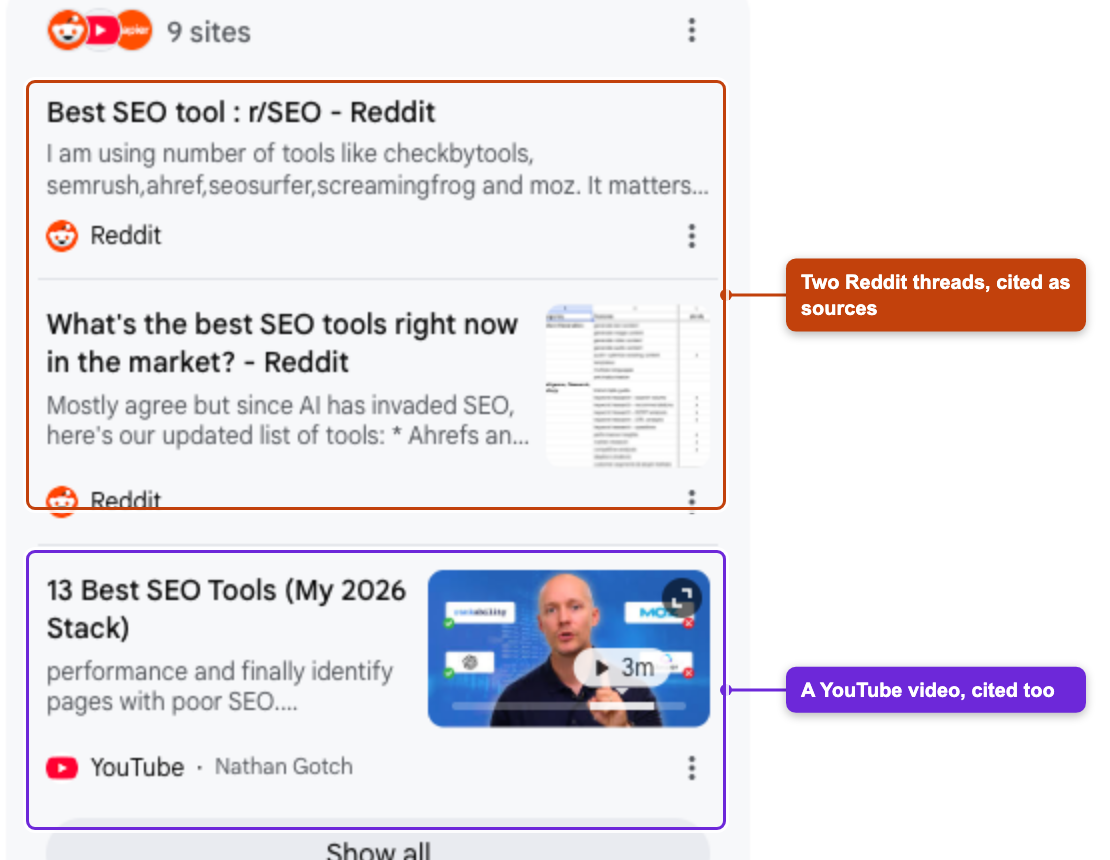
Google regularly cites Reddit threads and YouTube videos inside the AI Overview for these commercial searches, as an inline citation chip, a source card, or an embedded video. One more finding you can’t ignore.
I measured this myself across 41 queries, counting only sources genuinely inside the box, not the organic results below it:
Reddit shows up roughly twice as often as YouTube, usually as an inline chip tagged with the exact subreddit (r/sysadmin, r/nocode, and so on).
Google even embeds the video right in the answer body:
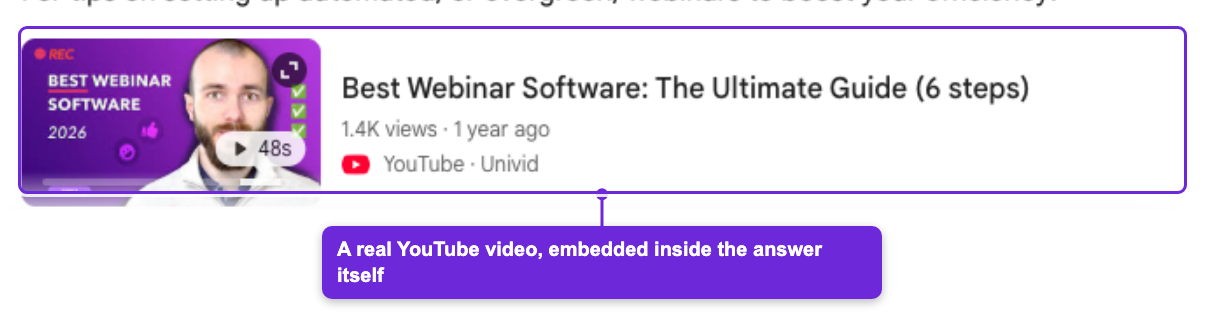
And here’s the kicker, which sets up the plays below: those cited videos are not from big influencers.
5 Plays to Get Cited (Even If You’re Losing Today)
So you’re getting ignored. Your rivals are in the box. What do you actually do?
Here is the exact playbook, built straight from the data above.
The Consensus Stack
You saw the ledger: citation follows consensus. So go manufacture consensus, legitimately.
- Get real reviews on G2, Capterra, and TrustRadius (these get cited constantly).
- Earn spots in independent “best of” roundups: even one or two moves the needle.
- Get genuinely recommended in Reddit threads for your category.
Mini case: PandaDoc and GetAccept both self-rank #1 for e-signature. PandaDoc shows up on Zapier, G2, and Reddit, so Google names it. GetAccept shows up nowhere else, so Google skips it. Same self-claim, opposite outcome.
The Slot Snipe
Stop fighting for “best [category] software.” You’ll lose to the incumbent every time.
Instead, pick one narrow “best for [specific use case]” you can credibly own, and build your page around it.
And if you’re in a niche or local vertical (home services, clinics, nonprofits, studios), this is your biggest edge. Consensus there is thin, so a well-built listicle of your own can become the reference Google leans on. In that batch of my audits, self-ranking worked 71% of the time.
Mini case: Fieldwire never challenged Procore for “best overall.” It claimed “best for field task management”, a slot nobody owned, and won it outright.
The Source-Seeding Method
Here’s the sneaky one. Your competitors write their listicles with AI. That AI pulls from a handful of sources.
So get into those sources first:
- Publish original data or a stat worth quoting. According to Princeton’s GEO study (Aggarwal et al., KDD 2024), adding statistics lifted AI visibility by 37% over an unoptimized baseline, the single largest gain the study measured. See the full breakdown in the AEO + GEO playbook.
- Seed the Reddit and forum threads Google is already citing.
- Make your key claim easy to copy so it spreads across other people’s posts.
Mini case: when a tool owns a quotable number, that number gets name-dropped across dozens of AI-written roundups, which becomes the exact consensus Google rewards in Play #1.
The Small-Creator Play
Everyone thinks you need a famous YouTuber. You don’t.
I checked the channels behind the videos Google cited. The results are wild:
- One channel’s cited videos had 52 and 76 views.
- Two creators had under 1,200 subscribers.
- Only 1 of 8 was a big influencer.
So target the small, reachable “software review” creators for a comparison video, and publish your own too (a 124-subscriber vendor channel got cited).
Mini case: a sub-1K-subscriber channel, “Thebusinessdive,” landed an embedded spot in the e-signature answer. That’s a realistic, cheap target, not a six-figure sponsorship.
The Liftable Line
Finally, hand Google the sentence you want it to steal.
Put a one-line verdict near the top of each entry: “[Tool] is best for [use case]” + a hard number (a price or a rating).
Mini case: Fieldwire’s page said “best for: task management and jobsite coordination.” Google’s answer came back “Fieldwire: Best for Field Task Management”, almost the same words. They pre-wrote the sentence, and got it.
The Bottom Line
Self-ranking on its own is still a vanity move.
But it’s no longer worthless. Pair it with consensus and a slot you can genuinely own, write it as a clean, liftable line, and Google will pull you into the answer, where it reads like an independent pick.
In 129 head-to-head audits, that combination got vendors cited 60% of the time. The ones who failed reached for a crown they didn’t own, and increasingly, the winners had Reddit and small YouTubers talking about them too.
Do that, and you stop begging Google to notice you. You give it no choice.
One caveat worth stating plainly: AI Overviews change. I re-checked several of these queries weeks apart and the wording, sometimes the picks themselves, had shifted. The pattern held every time. The exact sentences didn’t. So treat the screenshots as dated evidence of a mechanism, not a permanent leaderboard.
For the full framework behind all of this, read the AEO + GEO playbook, and if you want to see what’s actually being cited in your category, that’s exactly the audit I run for clients.
Now I’d like to hear from you: which of the 5 plays are you going to run first, the Consensus Stack, or the Small-Creator Play?