The clearest example of content that gets cited by AI is a short, self-contained passage that answers one specific question in its first sentence. We know because we ran it as a study: 20 Google searches across every query type, reading the AI Overview and every cited source on each one. The same handful of structures won every single time.
This is not a list of theories. Every example below comes from a real search you can reproduce right now, with the actual pages Google cited and the reason each one earned the slot. It applies the discipline from the AEO + GEO playbook to what search engines are demonstrably doing today.
How We Ran the Study
We searched 20 queries on Google, spanning definitions (“what is a backlink”), how-to guides (“how to do keyword research”), roundups (“best CRM for small business”), comparisons (“HubSpot vs Salesforce”), cost questions (“how much does SEO cost”), and troubleshooting (“why is my website not ranking”). To check the patterns weren’t marketing-specific, we included finance (“what is compound interest”) and consumer queries (“best running shoes for beginners”).
For each, we read the AI Overview, noted every cited source, and opened the winning pages to see which passage got lifted and why. The mechanism was always the same: content gets cited at the passage level, so the block that answers the question cleanest wins.
Definitions: The Answer-First Sentence
For every “what is X” query, the winning pages open with “X is [definition]” in the first sentence. There was no exception across seven definition searches.
Search “what is a backlink”and every ranked source leads the same way: “A backlink is when one website links to another” (Mailchimp), “A backlink, also known as an inbound link, is a link created when one website links to another” (Backlinko). Search “what is compound interest”, a completely different field, and it is identical: “Compound interest is the interest you earn on interest” (Investor.gov, Chase, CommBank, near word-for-word).
Featured snippets come from websites that Google finds. It picks them based on how well they answer your question and how helpful they are. (Google Search Help)
That is Google, cited on its own page for “what is a featured snippet”, stating the selection rule directly: answer the question well. The recurring winning tactics:
- Lead with “X is…”: the definition is the first sentence, never buried under an intro.
- Add the parenthetical: “(also known as an inbound link)” appeared on nearly every backlink result.
- Include the formula or example: the top bounce-rate page added “(unengaged / total sessions) × 100”.
How-To Guides: The Numbered Step List
For every “how to X” query, the cited content is a numbered list, one action per step, all in one place. Search “how to do keyword research”and the snippets are pure sequence: “Step 1: Identify topics. Step 2: Brainstorm. Step 3: Analyse” (StudioHawk), “1. Start with what you know. 2. Identify competitors. 3. Find keyword gaps” (Squarespace).
The pattern held on “how to increase website traffic”, where the titles themselves signal the format, “39 Ways,” “14 Effective Ways,” “10 Strategies”, and the body is a clean numbered run.
If your how-to scatters its steps across paragraphs, a model has to reassemble them and will reach for a cleaner source. Put the whole procedure in one numbered block.
“Best” Roundups: The “Best For X” Map
Recommendation queries are won by numbered listicles that map each option to a use case. Search “best CRM for small business”and Google’s AI Overview answers with exactly that: “Best for sales pipelines: Pipedrive; best for all-in-one marketing: HubSpot”, lifted from roundup pages structured the same way.
The best CRM for your small business depends on your specific needs, budget, and workflow. Here are the top systems:
The “best email marketing software”results map cleanly, “Brevo: best for growing businesses; HubSpot: best for enterprise; Moosend: best for SMBs” (Brevo’s own roundup). And it generalises far beyond software: on “best running shoes for beginners,”the winners are first-hand testing sites, RTINGS, The Run Testers, Doctors of Running, each mapping “best overall / best value / best for X”.
- Map option to use case: “Brand, best for [specific situation]”, not a flat ranked list.
- Signal recency and testing: “2026” and “(tested)” recurred in every winning title.
- Structure beats authority here: several cited roundups had near-zero domain authority but the right format.
Comparisons: The Labelled Verdict
For “X vs Y” queries, the lifted passage is a crisp, often literally labelled verdict. On “Semrush vs Ahrefs,”the cited line reads “Verdict:Ahrefs offers better value at the entry level ($29 Starter); Semrush provides more features per dollar at mid-tier” (SEOmator), and “Semrush wins overall… it outperforms Ahrefs in keyword research, LLM visibility, technical SEO, PPC, and pricing” (Backlinko).
Two things recur on comparison queries. Specific numbers get pulled, exact prices like “$29” and scores like “8.4 vs 7.2”. And the Discussions and forums block dominates: on both “HubSpot vs Salesforce” and “Semrush vs Ahrefs,” Google pulled multiple Reddit and Quora threads straight into the results, quoting the top comment.
Statistics and Numbers Beat Adjectives
A specific figure with a source was lifted on nearly every query that had one. On “how long does it take to rank,” the AI Overview leads with “3 to 6 months”. On “how much does SEO cost,”the forum block surfaced a hard number, “SEO costs $2,917 per month on average”, from an Ahrefs study. On “how to write a meta description,”Google synthesised a precise “150–156 characters”.
Ranking on Google typically takes 3 to 6 months to see initial traction, and 6 to 12 months to reach the first page for competitive keywords. The exact timeline depends on three main factors: content relevance, competition, and your website's domain authority. Whitehat SEO +1
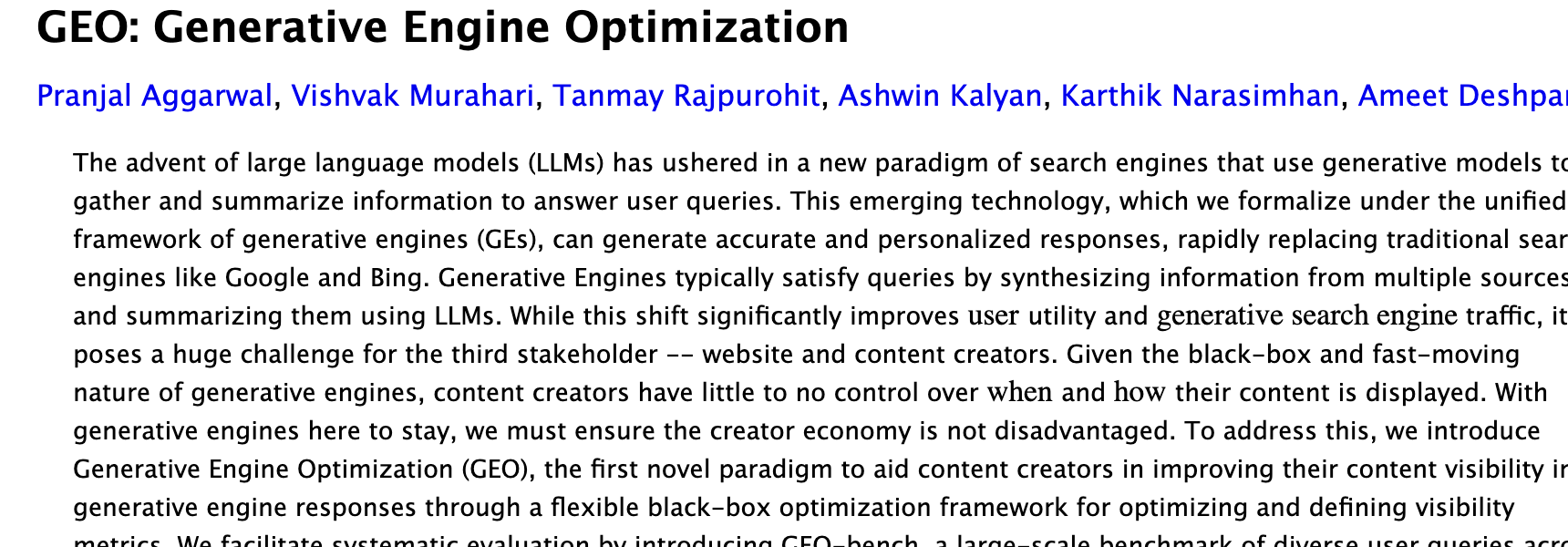
This is the one pattern with controlled evidence behind it. The Princeton and IIT Delhi GEO study tested nine tactics across ~10,000 queries and found adding statistics lifted AI visibility by up to 37%, and quotations by 22%.
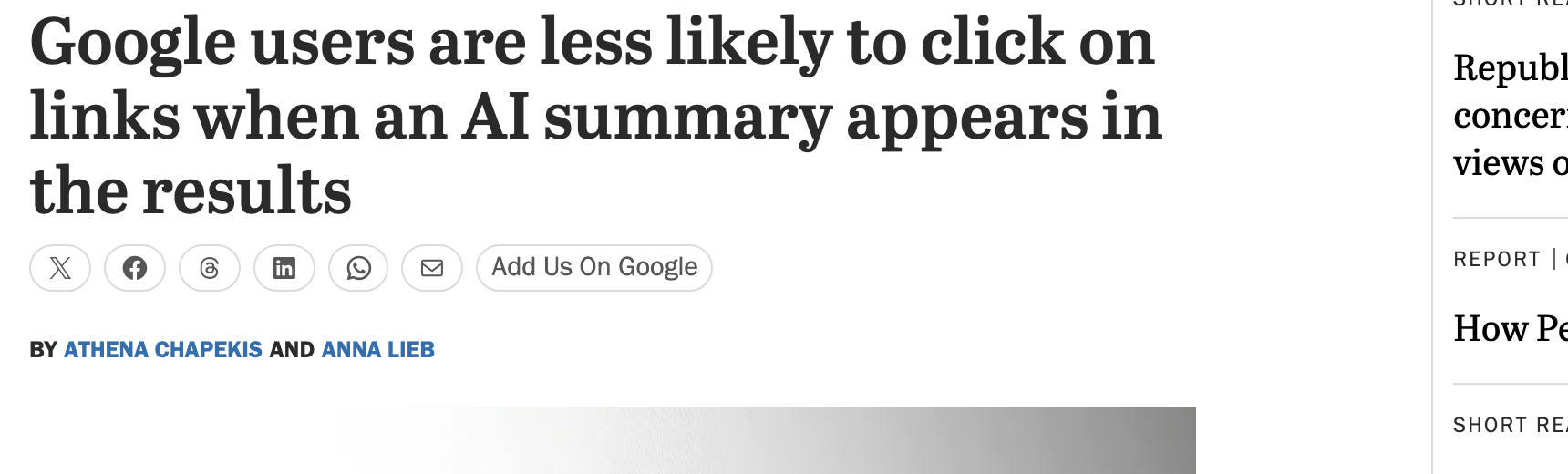
It is why original data is the hardest example to copy and the easiest to get cited: when you publish a number nobody else has, you are the only source to quote. Even the click figures this cluster relies on come from a single primary study.
Forum Answers Are First-Class Sources
The most surprising finding for most brands: Reddit and Quora were cited on roughly 8 of the 20 searches, in a dedicated “Discussions and forums” block, with the top comment quoted directly. It showed up on definitions (“backlink” cited r/SEO), cost, comparisons, troubleshooting, and even “best running shoes” (r/beginnerrunning).
Forum answers win because they do what most brand content refuses to: they lead with the answer and use the words people actually search. On “what is llms.txt,”the cited Reddit line was simply “It’s like a cheat sheet for AI models”, plainer and more quotable than any vendor page.
If a forum comment can take the citation, a properly structured page can take it back, by matching the directness, not by out-branding it.
Reverse-Engineering a Winner, Step by Step
To show the method concretely, take “what is schema markup.”Google’s AI Overview lifted “Schema markup (also known as structured data) is a standardized code added to your website’s HTML,” citing Semrush. We opened the Semrush page to find the source of that sentence.
Schema markup (also known as structured data) is a standardized code added to your website's HTML. It acts like an explicit "name tag" for your content, translating human-readable text into a specific, machine-readable format that search engines and AI systems can easily understand and categorize. Umbraco +3
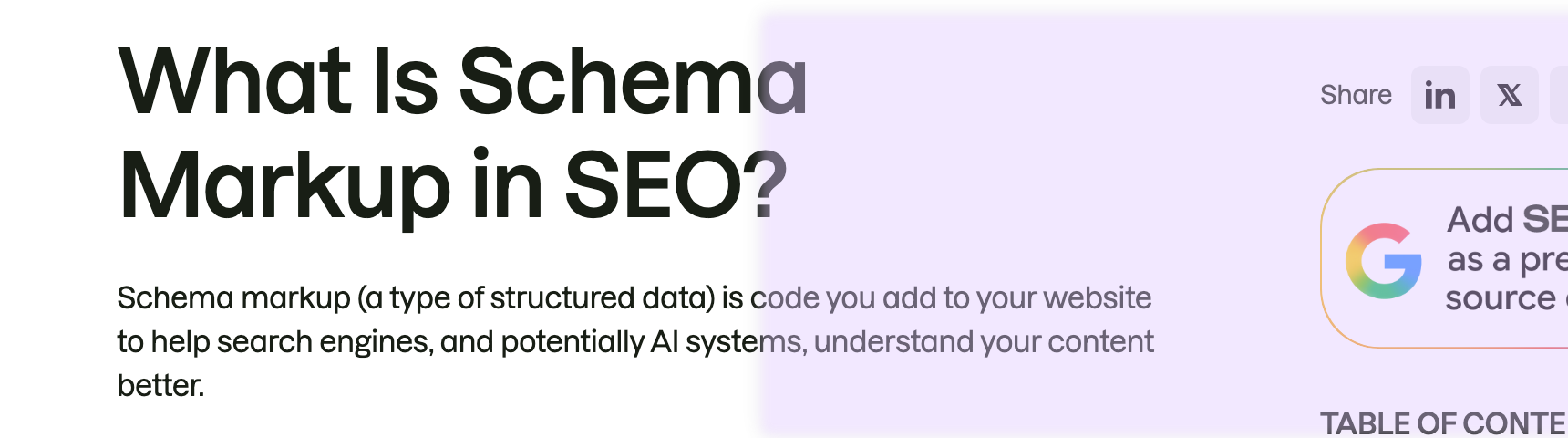
The matching sentence sits directly under a heading titled “What Is Schema Markup in SEO?”, and every H2 on the page is a question, each resolved in the sentence below it. The heading is the query, and the answer is the first thing under it.
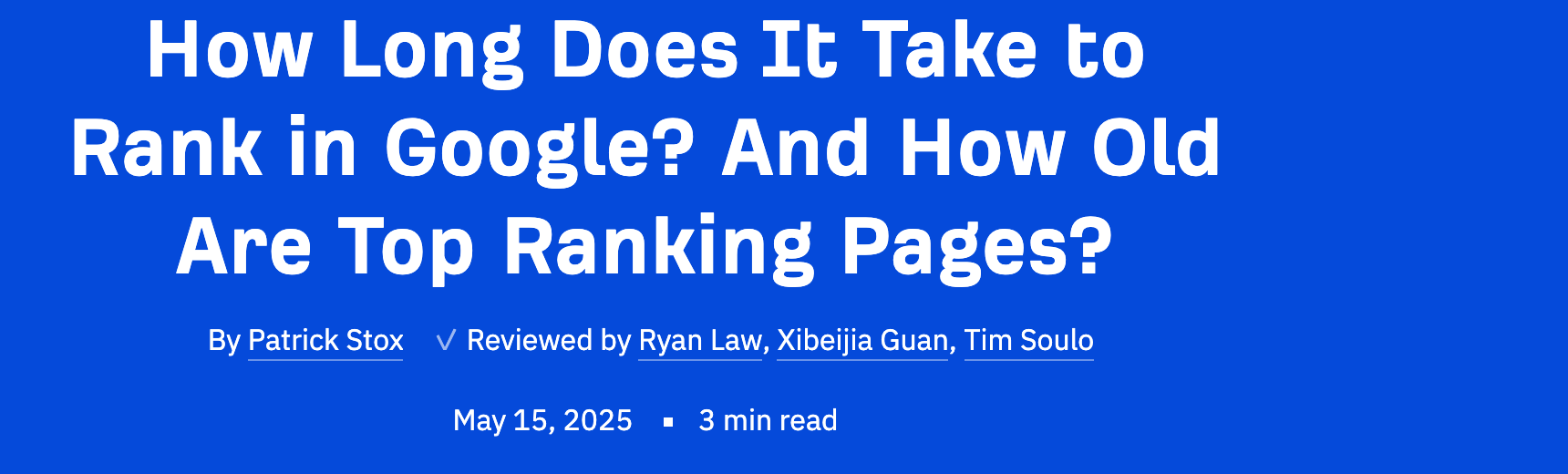
Authority helps too, but it is legible on the page, not just in the domain. The Ahrefs article cited for “how long does it take to rank” leads with a named author, named reviewers, and a visible date.
The four-step method
- 1Run the query you want to win and read the AI answer.
- 2Note the cited domains listed beside or beneath the answer.
- 3Open the top cited page and find the passage that matches the answer.
- 4Copy the structure, not the words: the heading, the answer-first opening, the format, then out-answer it.
What Always Wins, Regardless of Topic
Five patterns held across all 20 searches, from “backlink” to “compound interest” to “running shoes.”
- Answer-first is universal. Every winning passage led with the answer, in every vertical, without exception.
- Originators win their own terms. Moz ranked first for “domain authority” (which it coined), Google’s docs for its own features, llmstxt.org for “llms.txt”.
- Small sites can rank beside giants when they answer first, a blog was cited next to Ahrefs, a DA-59 site next to Moz.
- Except in YMYL. For finance, authoritative institutions dominated, Investor.gov, Investopedia, Chase, with no small blogs in sight.
- Specific numbers get lifted. 3–6 months, 150–156 characters, $2,917, $29, 40%. Figures beat adjectives every time.
Test It On Your Own Content
You do not have to trust the study, reproduce it. Pick a query you should own and search it. See who gets cited, open their page, and find the passage that won. Almost always it will be one of the formats above, answering the question in its first line.
The fastest place to test your own pages is Perplexity, because it shows its sources on every answer. If it cites a competitor instead of you, study their structure and out-answer it; log the results over time as your AI share of voice. To win the specific surface most searches now end on, see how to win a Google AI Overview citation, and for the full discipline behind all of it, the AEO + GEO playbook.
Across 20 searches the verdict was the same: answer the exact question in the first sentence, structure it so a machine can lift it whole, and prove it with a number. That is the entire game.